First study comparing gas, propane, and all-electric commercial kitchens documents temperatures as high as 122°F (50ºC) and nitrogen dioxide above the EPA’s one-hour outdoor air standard in 70% of gas and propane kitchens
[OAKLAND, Calif.] — Restaurant workers in commercial kitchens with gas and propane appliances can face heat and air pollution at levels above health-based guidelines, according to a new study by researchers from PSE Healthy Energy, the Stanford Doerr School of Sustainability, and New York University Grossman School of Medicine, in collaboration with Chef Christopher Galarza.
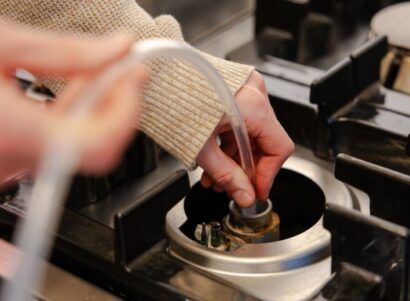
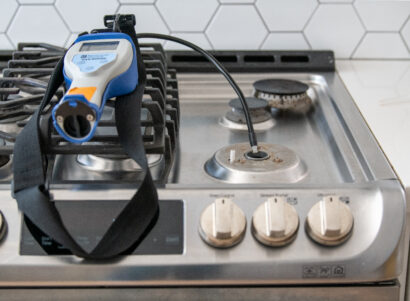
The peer-reviewed study, “Combustion-Derived Air Pollution and Heat from Gas-fired Appliances in Commercial Kitchens Can Exceed Health-Based Guidelines,” published in Environmental Research Letters, is the first U.S. analysis to compare air quality and heat exposures in commercial kitchens equipped with gas-fired appliances to those that are all-electric under real-world working conditions. The research team measured nitrogen dioxide (NO2), benzene, carbon monoxide, carbon dioxide, methane, and air temperature in areas where employees work during restaurant service and overnight. The research, based on measurements from 21 gas kitchens, three propane kitchens, and three all-electric kitchens across California, Pennsylvania, and New York, has implications for workers across the U.S. restaurant and food industry, which employs an estimated 15.7 million people. About five million of those employees spend all of their working hours in the kitchen.
“Very few studies have measured what cooks and chefs breathe during a normal shift,” said lead author Yannai Kashtan, PhD, air quality scientist at PSE Healthy Energy. “In some gas kitchens, we observed that several pollutants exceeded health-based guidelines, while the all-electric kitchens ran cooler and cleaner than those using gas or propane appliances.” This research is part of PSE Healthy Energy’s Methane + Health Initiative which aims to improve the scientific and public understanding of the link between methane emissions, air pollution, and public health.
While no all-electric kitchen exceeded health guidelines for pollution exposure during cooking hours, researchers recorded one or more exceedances in most kitchens with gas or propane appliances. For NO2, a pollutant associated with higher risk of asthma, approximately 70% of the gas kitchens exceeded the U.S. Environmental Protection Agency’s (EPA’s) one-hour outdoor air standard of 100 parts per billion by volume (ppbv) during working hours. In one kitchen, a 15-minute average NO2 measurement exceeded 1,000 ppbv, the National Institute for Occupational Safety and Health’s (NIOSH’s) recommended limit for short-term workplace exposure. Concentrations of carbon monoxide and the known human carcinogen benzene exceeded California’s 1-hour exposure guidelines in three and five gas kitchens, respectively.
“Commercial kitchens have received much less attention than home kitchens for measuring indoor pollution,” said study co-author Rob Jackson, PhD, Professor of Earth System Science at the Stanford Doerr School of Sustainability. “Our study shows that burning gas in a restaurant kitchen is as suspect as burning it in our homes. All-electric kitchens emitted none of the pollution we saw in kitchens burning gas.” Jackson is faculty director of Electrification for Health, a program of the Stanford Center for Human and Planetary Health, that works to protect human health through clean electric systems that reduce air pollution indoors and outdoors and meet people’s energy needs.
The study also provides new evidence of an exposure pathway from gas appliance pilot lights that consistently remain lit, raising concerns for cleaning crews and early-arriving staff. Approximately 71% of the gas kitchens with overnight monitoring recorded higher levels of NO2, carbon monoxide, carbon dioxide, methane, and benzene overnight, when ventilation was off and pilot lights remained lit, than during restaurant service. Seven kitchens exceeded the 100 ppbv NO2 standard during off-work hours. None of the all-electric kitchens exceeded pollutant thresholds overnight.
“Some of the highest indoor pollution levels we measured came when no one was cooking at all,” said study co-author Drew Michanowicz, DrPH, MPH, CPH, principal scientist at PSE Healthy Energy. “Overnight, continuously burning pilot lights and shut-off ventilation pushed levels above what we saw during service in some restaurants. The same commercial-grade appliances are used in schools, hospitals, and mixed-use buildings, so the health risks probably reach far beyond the people working in restaurants.”
The study found kitchens equipped with gas-fired appliances frequently exceeded heat-based health benchmarks. Approximately 68% of the gas kitchens with temperature data exceeded 90°F (32ºC), the proposed federal Occupational Safety and Health Administration (OSHA) high-heat threshold. Ten of those exceeded 100°F (37ºC), and four exceeded 122°F (50ºC). Even when outdoor temperatures remained below 75°F (23ºC), 10 of 13 gas kitchens exceeded 90°F (32ºC) indoors, suggesting that heat generated inside the kitchen, rather than hot weather alone, drove the extreme indoor conditions. To get a closer look at the heat an individual worker may experience, the team attached a temperature monitor to a chef’s shoulder during a roughly five-hour controlled cooking session. The monitor recorded an average temperature of 92°F (33ºC) and a peak of 106°F (41ºC).
“Restaurant kitchens are demanding and oftentimes inhospitable workplaces that our staff are expected to work hard in. They shouldn’t have to sacrifice their health by accepting excessive heat or polluted air as part of the job,” said study co-author Chef Christopher Galarza, CEC, CCA, ECC, ECP, WCEC. “This study gives restaurant owners and chefs better information about the conditions inside commercial kitchens and the role equipment choices can play in creating healthier workplaces.”
###
About PSE Healthy Energy
PSE Healthy Energy (PSE) is a scientific research institute generating energy and climate solutions that protect public health and the environment. PSE provides expertise in public health, environmental science, and engineering and brings science to energy policy through actionable research, communications, and advising. Visit us at psehealthyenergy.org.
Media ContactMamelang Memela, PSE Healthy Energy Communications Consultant, mamelang@sunstonestrategies.com, 503-839-1360
PSE ContactEdith Stone, PSE Director of Communications, communications@psehealthyenergy.org

 Read more about the study