Report Introduction
The New Mexico Environment Department (NMED) has proposed a state Methane Abatement Rule that includes a super-emitter program, with a public hearing before the Environmental Improvement Board beginning December 1, 2026. Methane super-emitter events are conventionally defined as releases of 100 kilograms of methane per hour (kg/hr) or more, the threshold used by the U.S. Environmental Protection Agency’s (EPA) federal super-emitter program (on pause as of July 2025 and likely to be rescinded). NMED’s proposed super-emitter program would lower the threshold to 50 kg/hr, bringing events of 50–100 kg/hr under the same scrutiny as larger events for the first time.
For this report, PSE analyzed all New Mexico methane emissions events currently included in the Methane Risk Map (MRM). These are events detected by Carbon Mapper’s satellite and aircraft surveys that could be attributed to an upstream oil and gas source and for which PSE has gas composition data. The results bring insights from 779 methane emissions events detected between 2016 and 2026, including methane releases <100 kg/hr. Across these events, we show how often and how far from the source co-emitted benzene exceeds health-based benchmarks and the potential scale of the population affected.
To review the full report, download it below.
Four Takeaways From the Methane Risk Map
New Mexico Has Hundreds of Methane Emissions Events and Nearly All Have Benzene Risk Exceedances
The MRM modeled 779 methane emissions events that occurred in New Mexico between 2016 and 2026. Almost all of these events occurred in Eddy (491) and Lea (287) Counties (Figure 1). Of the 779 New Mexico events analyzed, 99.6% had modeled benzene concentrations above the California Office of Environmental Health Hazard Assessment (OEHHA) acute 1-hour Reference Exposure Level (aREL) of 8 ppb. Therefore, nearly every methane emissions event modeled in the state may have produced short-term benzene levels that are unhealthy to breathe.
Figure 1: Methane emissions events in New Mexico, 2016–2026. Locations of the 779 events modeled on the Methane Risk Map (MRM) and included in this report analysis. Darker blues indicate more events.

Tens of Thousands of New Mexicans Live in Benzene Risk Areas From Methane Emissions Events
Approximately 19,800-46,500 New Mexicans, about 1-2% of the state’s population, live within at least one modeled benzene risk area. While many of the state’s methane emissions events have occurred in rural areas with populations of less than 100 people within the risk area, a few events near populous areas like Carlsbad, Hobbs, and Loving may have put many New Mexico residents at risk. About 2% (18) of the modeled events have more than 1,000 people living within the modeled benzene risk areas. The vast majority of such events occurred in Eddy County, where an estimated 23-65% of the population (14,200-40,900 people) may have experienced at least one short-term benzene exposure above health-based benchmarks.
Statewide, between 20 and 82 sensitive facilities fell within at least one modeled risk area, with schools and parks being the most common. Sensitive facilities, such as schools, childcare centers, parks, hospitals, nursing homes, and correctional facilities, serve people who are especially sensitive to air pollution due to developmental age or health status.
Some Eddy County Communities Fall Within Risk Areas Again and Again
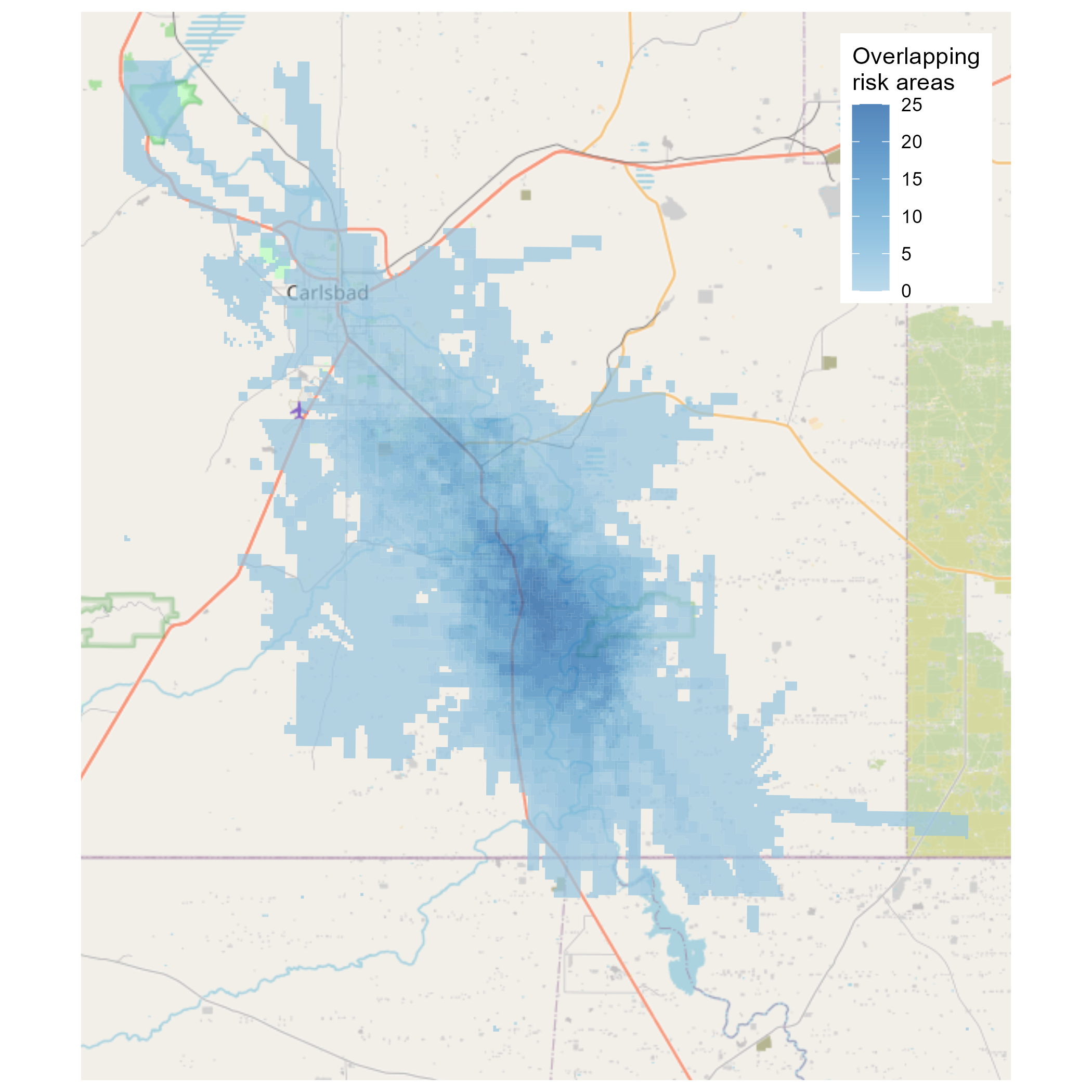
The MRM shows repeated methane emissions events around Carlsbad and Loving from 2016 through 2026, and their benzene risk areas overlap substantially (Figure 4). About 9-18% of Eddy County residents live where the risk areas of more than two separate events overlap. Although MRM does not model long-term risk, repeated methane emissions events in the same geographic area raise the question of whether residents could also face elevated chronic benzene exposure from methane emissions events.
Figure 4: Overlapping benzene risk areas in Eddy County. The map shows the modeled risk areas of methane emissions events with at least 100 people living inside them. Darker blue tones indicate places where more events’ risk areas overlap.
New Mexico’s Setback Distances Fall Short of Protecting Health
Modeled benzene exceedances routinely reach well beyond local setbacks, the minimum distance oil and gas infrastructure must be from homes, schools, or other sensitive facilities. The City of Carlsbad requires a setback distance of 500 feet, and Eddy County requires a setback of 300 feet, while there is no statewide setback. Established local setbacks may not be sufficient to reduce health risks since almost every modeled upstream methane emission event in New Mexico produced modeled benzene concentrations that exceeded the health risk threshold of 8 ppb beyond 300 feet from the source. Of the 99.4% of emission events with modeled benzene exceedances, every event produced exceedance distances of at least 300 ft. The median farthest exceedance of all events in New Mexico was about 3400 feet from the source. Even for events with emissions rates of 50-100 kg/hour, the median farthest exceedance was around 1500 feet. These results suggest that current local setbacks do not adequately protect public health.
Policy Context and Opportunities
Despite this federal methane policy potential rollback, states, counties, and cities can take several actions to reduce health risks associated with methane emissions. In August 2026, the New Mexico Environment Department petitioned the state’s Environmental Improvement Board to adopt a new Methane Abatement Rule, 20.2.51 NMAC (docket EIB 26-78(R)). The public hearing is scheduled to start December 1, 2026. As proposed, the rule would:
- Define a super-emitter event as a release of 50 kg/hr or more detected by an approved remote sensing method, half of EPA’s 100 kg/hr threshold.
- Require operators to investigate and repair within three calendar days of notification, with detections submitted by certified third parties.
- Set a zero methane emission standard for process controller-designated, natural gas-driven facilities, beginning in 2031.
The MRM results can inform the Board’s decision, as well as measures beyond the rule:
- Emissions threshold: Methane emissions events of 50 to < 100 kg/hr, below the federal threshold of 100 kg/hr, produced modeled benzene exceedances, typically within about a third of a mile of the source. A 50 kg/hr threshold captures releases with documented health relevance.
- Prioritizing storage tanks and flash gas: Storage tanks make up about 20% of the modeled New Mexico events, but nearly all of the population risk. Policy and enforcement that prioritize flash gas sources would focus effort where the greatest health benefit is.
- Transparency on equipment type: Many methane emissions events cannot be tied to a specific equipment type. Public reporting of infrastructure and oil and gas equipment databases would facilitate better risk assessment and help identify flash gas sources.
- Gas composition data: Requiring operators to report gas composition, and making these data publicly available, would allow the public and regulators to quickly assess the health risks associated with an event as soon as an emissions event is detected.
- Accurate, timely reporting: Methane-monitoring satellites are revealing that super-emitter events are more frequent and larger than reported, and Earthworks recently documented major under-reporting in New Mexico’s Permian Basin (Earthworks, 2026). Unreported events delay mitigation and health risk assessment, prolonging emissions and exposures.
- Health-based setbacks: Local setbacks of 300–500 feet fall far short of most modeled benzene exceedance distances, which have a median of about 3,400 feet in New Mexico. Modeled risk areas could inform setbacks that better protect health, especially around flash gas sources.
For a broader discussion of policy recommendations addressing methane super-emitters, including six recommendations that extend beyond New Mexico, see our policy brief, How Methane Emissions Events Impact Air Quality and Put Human Health at Risk, available through the Federation of American Scientists.

 Read the full report