Direct Air Capture Technologies: Evaluating the Benefits, Risks, and Scalability
Burning fossil fuels is the leading driver of climate change, and finding ways to reduce carbon dioxide (CO₂) in our atmosphere is one of the defining challenges of our time. One emerging technology gaining attention is direct air capture (DAC), which removes CO₂ directly from the atmosphere. This technology has been increasingly promoted as a necessary complement to emissions cuts and has spawned a robust literature that assesses whether DAC actually removes CO₂. However, the literature does not directly address a question central to determining when, where, and at what scale DAC should be deployed: if one spends a dollar to build DAC, how much climate and health benefit could one achieve if one spent that dollar on solar or wind instead? Prior studies have focused on carbon accounting, overlooking the public health impacts of different energy investments on surrounding communities, which this study directly addresses.
PSE Healthy Energy, in collaboration with researchers from Boston University School of Public Health and Harvard T.H. Chan School of Public Health, published a new peer-reviewed study in Communications Sustainability providing the first regional, quantitative assessment of the opportunity cost of DAC. This study explores whether investments in DAC or renewable energy deployment yield greater cost-effectiveness and health benefits, now and through 2050.
The researchers modeled the climate and local health impacts of deploying a DAC facility across multiple grid regions in the U.S. They similarly modeled the impact of allocating the same capital to onshore wind and utility-scale solar deployment. This allowed the researchers to find that the opportunity cost of investing in DAC is high under current and likely conditions through 2050 because it can displace investments in renewable energy deployment, such as wind and solar, that deliver greater climate, public health, and equity benefits per dollar.
Key Findings
Renewables win in most scenarios.
In three of the four scenarios we modeled, as shown in Figure 1, deploying capital to build out utility-scale solar and wind is a more cost-effective way to reduce CO₂ emissions than building a DAC facility, regardless of whether the DAC facility draws power from the grid or from its own dedicated renewable source.
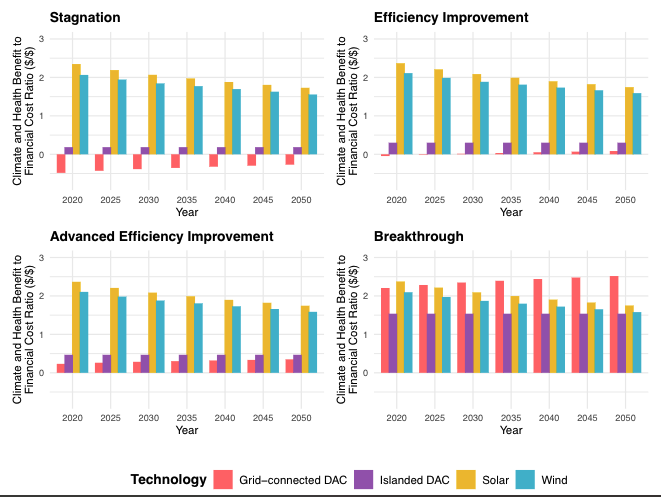
DAC can only compete under a major technological breakthrough.
In one scenario where the cost of DAC drops to $100/ton CO₂ and efficiency reaches 800 kWh/ton CO₂, an extraordinarily optimistic scenario, grid-connected DAC becomes the better investment in much of the U.S. However, even in this scenario, solar and wind remain the smarter choice in many areas, like in the coal-heavy Midwest, where adding load to the grid imposes large health costs.
DAC increases negative health impacts.
In every scenario and every year, renewable energy deployment improves local air quality by taking fossil fuel plants offline or reducing the amount of fossil fuels they burn. In contrast, grid-connected DAC generates local air pollution and negative health impacts, concentrated in the communities near the fossil fuel power plants that supply its electricity. Even DAC facilities powered by purpose-built renewables do not provide the health benefits of reducing fossil fuel use, and use renewable energy that could be used to displace fossil fuels.
Conclusion: Is Direct Air Capture the Solution?
Based on the analysis, the researchers identified the grid regions where DAC is likely to beat cost-equivalent renewables the earliest in the energy transition, and the approximate break-even date under different scenarios. With moderate assumptions, the researchers find that California is the only grid region where DAC beats cost-equivalent renewable alternatives before 2050, doing so in 2035. Nationwide, DAC is preferable to a cost-equivalent renewable buildout by 2050 only if it were to undergo a massive technological breakthrough and dramatic cost reductions.
This research is designed to inform real decisions occurring today and is geared toward several groups. First, policymakers must decide on tax incentives and capital allocation. Second, DAC investors must similarly allocate capital and often make a case that their investment yields a high climate return on investment (ROI). Third, leaders of DAC host communities will likely find our quantification of local air quality impacts particularly useful in weighing the costs and benefits of DAC to their communities.
The analysis conducted by the researchers in this work is simple yet powerful: every dollar spent is a dollar lost elsewhere. Our goal with this study is to help decision makers understand the technologies they are choosing between.

 Read the full study here